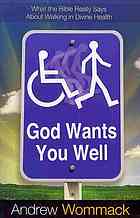
Two runny noses. That’s it. Over the past 40 years, this is the only sickness the author has experienced, and he expects the same for you. American pastor and evangelist Andrew Wommack wrote
God Wants You Well in hopes of persuading people that it is never God’s will for Christians to be sick.
Is this true? If Jesus consistently healed the sick in the Gospels, should we expect him to do this today? Won’t the suffering of Christians hurt the gospel? Is suffering and sickness the work of God or of Satan? Does a loving God ever
desire his children to hurt, suffer, and weep? Wommack tries to answer these questions.
Big Idea: Wommack’s thesis is that : it is always God’s will to heal us. Sickness is never a blessing but always a curse. Wommack bolsters this idea by presenting the classic Prosperity promise: “God will heal you and keep you healthy. He’ll deliver you from depression, despair, and strife that you find yourself in. God will prosper you in a way that you could never accomplish just through your own effort” (10-11).
One of his basic arguments is that if Jesus and the early believers needed miracles, signs, and wonders to confirm God message, then we do too, and it is the height of arrogance to deny this (7). After all, one of the primary reasons Jesus came was to cure the body
on earth. On the cross, Jesus suffered for our physical healing. “Jesus took our diseases just as much as He took our sins” (1).
Wommack knows the arguments that contest him and aggressively opposes them. In response to the claim, “[God is] putting sickness on you to teach you a lesson”, Wommack proclaims: “That’s absolutely untrue!” (11) Like all false teaching, there are some kernels of truth in this book. For example, it is true that Jesus healed the lame man in Mark 2 “so that people would know that He also had power on earth to forgive sins” (4). But it is false to conclude from this passage that is always to heal believers today.
This work is littered with errors. I have divided them into three categories below.
Logical Errors
- Lack of support – Wommack loves making bold claims with no verification. For example, he gives no citation when saying: “Jesus spent more time talking about healing than He did several other truths that many people consider to be essential issues today—heaven and hell in particular.”
- Excluded middle – On page 12, Wommack presents two responses to suffering: “The Lord put the sickness” on someone who died or it was not God’s desire that someone was sick. But he never presents a third option like “God allowed this to happen for his own glory.”
- Loads of Scripture with no explanation (173-201) – Satan quotes Scripture to twist truth. Wommack seems to think that 30 pages of Scripture quotes bring him closer to truth. In this section, there was no comment, only blocks of Scripture passages.
- Straw man – “When I’ve tried to start talking to drug addicts, prostitutes, and adulterers about receiving deliverance from God, many of them have told me, ‘Well, like the apostle Paul, I’ve just got a thorn in the flesh’” (52).
- False syllogism – Wommack’s syllogism in chapter five (p. 31ff) goes like this: Jesus always does the will of His Father. Jesus healed the sick. Therefore, it is always the will of the Father that the sick be healed.
Theological Errors
- Attacks the sufficiency of Scripture – “If Jesus needed the witness of the miracles He performed to validate His authority, then how can we possibly do less? It is the height of arrogance to think that we can use words only to persuade people when Jesus had to have signs and miracles to confirm His Word.”
- The power of words and Mark 11:23 (147-157) – Audible spoken words have power. Thus, Prosperity preachers encourage us to “say it”. We must speak the thing we want.
- The “gospel” presentation without sin (203-205) – there is no mention of sin in his closing gospel presentation. And why should there be? People are coming to Wommack’s Jesus for a fulfilled life, not forgiveness.
- False proof – He writes: “If you study the Hebrew meaning of the words in the original language here, especially in verse 4, they clearly refer to physical healing” (27). He never bothers to show us the Hebrew.
- “God is not the author of sickness—He’s the author of healing” (32). Contrast this with Exodus 4:11, “Then the Lord said to him, “Who has made man’s mouth? Who makes him mute, or deaf, or seeing, or blind? Is it not I, the Lord?”
- Calloused Counsel – Wommack told the parents who were grieving over the loss of their four-year old child: “It’s either my fault, your fault, both of our faults, or things that we don’t understand. I don’t know what it is, but I can guarantee you it’s not God” (46). Contrast this with Job’s words after losing all of his children: “Naked I came from my mother’s womb, and naked shall I return. The Lord gave, and the Lord has taken away; blessed be the name of the Lord” (Job 1:21).
Exegetical Errors
- In 2 Corinthians 8:9 we find, “For you know the grace of our Lord Jesus Christ, that though he was rich, yet for your sake he became poor, so that you by his poverty might become rich.” Wommack states that this passage “is very clear concerning…our redemption from poverty. That is, by Christ’s death, God has provided everything for us, including healing, deliverance, and financial prosperity. There are at least three problems with interpreting this verse in this way. (1) This passage was written to the Macedonians, who just a few verses earlier were said to be enduring “extreme poverty” (vs. 2). Jesus’ physical poverty certainly did not make them rich. (2) That Christ “was rich” and “became poor” most likely refers to the leaving of the splendor of glory and humbling himself through the incarnation. He “became poor” in that He took on human flesh and became sin for us (2 Cor. 5:21). We become “rich” in that we become the righteousness of God. This idea is closely linked to Philippians 2:6, “who, though he was in the form of God, did not count equality with God a thing to be grasped.” (3) Wommack had just told us earlier that we are to imitate Jesus. So if “poor” means physical poverty, then consistency demands that Wommack tells Christians to be poor in order to imitate Christ.
- Sozo – Wommack correctly observes that the Greek word “sozo” has many meanings in Scripture. For example, he cites Matthew 1:21 where “sozo” is used in reference to forgiveness of sins (“He shall save His people from their sins”). Then he cites other passages where “sozo” is used in reference to physical healing, like when Jesus told the woman with an issue of blood: “your faith has made you whole [sozo].” But then things start to go awry. Wommack wants to meld all the uses of “sozo” into one definition under the term “salvation” and claim that it includes both the forgiveness of sins AND freedom from sickness, disease and poverty (19). A few observations are in order. First, all the forms of “sozo” are used over a hundred times in the NT. While it has many usages, its essential meaning is deliverance. The context will tell us from what we are delivered. These can be divided into three main categories. (1) Deliverance from danger. (2) Deliverance spiritually and (3) Deliverance physically. The vast majority of times has “sozo” fitting into the second category. Second, it is a large and exegetically irresponsible jump to move from “sozo” having many meanings to claim “salvation includes the forgiveness of sins as well as the healing of the body and deliverance from poverty.” Third, we know that “sozo” cannot encompass all of these things at once, for if it did, women would receive the forgiveness of sins through childbearing (1 Tim. 2:5), or people would be “suffering loss” and receiving material gain at the same time (1 Cor. 3:15).
- 1 Peter 2:24 – Wommack quotes 1 Peter 2:24 (“by whose stripes ye were healed”) as teaching that “Christ paid for the healing of our body as completely as He paid for the forgiveness of our sins” (21). But this certainly cannot be right. First, there is nothing in the context that would make “healed” refer to physical cures. The opposite is true. Verse 19 says that “we” (Christians) will suffer unjustly, not live a life of prosperity. Verse 20 avers that it is a good thing when we suffer and endure. Further, we find in verse 21 that Christ suffered and that we should follow his example. Second, Christ actually bore the sins of Christians (“our”) on the cross. So if Christians are actually physically healed by Christ’s death, then this would mean that Christians will never be sick.
- Use of Mark 16:17-20 – He uses this passage to claim, “if ministers do not have the miraculous power of God flowing through them, then we should be skeptical about whether or not God is truth speaking through them” (5-6). Three observations are in order. (1) We should read with caution this passage, as many dispute if Mark 16:9-20 should be included in the canon. (2) The apostles did these things, but Wommack fails to acknowledge the unique power they had at this time. (3) There is no command to do this.
- James 4:7 – Wommack assumes that all sickness comes from sin and Satan. He quotes this verse (“Resist the devil, and he will flee from you”), then says, “How can you actively fight against the devil—and the sickness, infirmity, and disease that come from him—if you think God is the One who is sending it instead” (24)? Clearly, Wommack sickness as equal to sin. He claims, “in the same way that I should resist sin, I should resist sickness” (36) and writes: “I am condemning the attitude that says, ‘Sickness is something God wants for us.’ That attitude is just as bad as saying, ‘Sin is something God wants for us.’” (25) Wommack is guilty of making the same mistake the disciples did in John 9 when they assumed that sickness comes from sin. “As he passed by, he saw a man blind from birth. 2 And his disciples asked him, “Rabbi, who sinned, this man or his parents, that he was born blind?” 3 Jesus answered, “It was not that this man sinned, or his parents, but that the works of God might be displayed in him” (John 9:1-3). Further, Philippians 1:29 views suffering as a gift from God, not Satan.
- 2 Corinthians 12:7-10 and Paul’s thorn in the flesh – First, Wommack claims that Satan was the active agent in giving Paul the thorn in the flesh, saying “Satan gave him a thorn in the flesh. It was from the devil, not God” (51). But verse 7 says, “A thorn was given me in the flesh, a messenger of Satan to harass me.” Nowhere does it say that Satan was the one giving the thorn. Second, Wommack seems to be saying that persecution may be God’s will, but not sickness (54-55). What if you become sick because of persecution? Third, he suggests that Paul had temporary sickness (like bad eyesight), but gets around this by saying “it probably took Paul some time to mend” (64).
- 1 Timothy 5:23 – Though it seems that Paul is subscribing medicine (“a little wine”) for Timothy’s “often infirmities”, Wommack says this is not an endorsement for medicine. Rather, the water had made him sick and Paul is telling him to stop drinking water and start drinking wine. But if sickness is never God’s will, how did Timothy get sick in the first place? Is sickness from Satan, or from tangible things like bad water?
Conclusion
For all of its wild biblical aberrations and logical fallacies, this book is at least consistent. It is the plausible conclusion to the Prosperity Gospel and Liberation Theology. Believers must actively resist this teaching, and heed Paul’s words in Acts 20:29-30. “I know that after my departure fierce wolves will come in among you, not sparing the flock;
and from among your own selves will arise men speaking twisted things, to draw away the disciples after them.”