







–– Lennox Kalifungwa
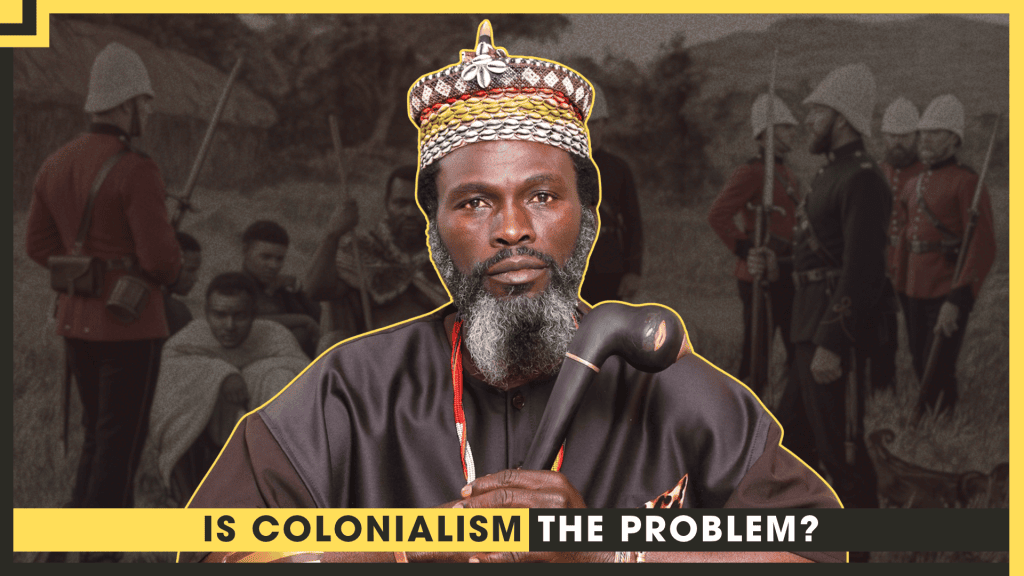
“Colonialism is to blame!” This widely repeated mantra purports to identify the root cause of Africa’s numerous problems. The claim is that Africa’s plight is fundamentally a consequence of exploitation and the erasure of indigenous identity by colonial powers. Two common responses call for liberating Africa from Western influence: one advocates a humanistic political order that employs socialism to remedy social injustices; the other calls for a return to an African order with its own distinct epistemology, customs, and spirituality.
One of the latter’s most notable advocates is Joshua Maponga, a Zimbabwean-born pan-African commentator who promotes the restoration of indigenous African spirituality, cultural identity, and intellectual independence. Maponga is outspoken in his skepticism about Christianity, often accusing it of being a tool of colonial oppression. In a recent social media post, he made several claims about religion that warrant confrontation and refutation.
When Christians encounter these ideas, how should we respond? What do we need to know to give a reason for the hope that lies in us?
Let’s confront Maponga’s prominent claims.
Claim #1: Religion has failed to liberate Africa. Despite widespread Christianity and Islam, Africa remains impoverished, divided, and exploited.
Africa is certainly a deeply religious continent, with Christianity and Islam its most popular religions. At the outset, however, Islam must be distinguished from Christianity. It is a false religion ushered in by a man who conferred with demons and sexually abused children. It denies the deity of Christ and produces oppression rather than freedom. Critiques of Islam’s failure to produce liberation are warranted: a religion premised on lies cannot produce true freedom.
To aim the same critique at Christianity is fundamentally dishonest. Christianity has produced the most liberated and prosperous cultures. It possesses the highest view of humanity, acknowledging that all men are made in the image of God. It confronted and ended slavery, produced great advancements in science and medicine, and gave rise to universities and the highest order of academic thought.
While many in Africa claim to be Christians, their Christianity often fails to acknowledge that Yahweh will have no other gods before Him. Many embrace antithetical beliefs and practices as though they can coexist. Christianity is confined to private spaces and one day of the week, rather than brought to bear on every aspect of life. In other words, Africa has yet to become Christian in more than name.
Claim #2: Religion was weaponised by colonial powers. European colonisers used Christianity to justify slavery, land dispossession, and economic exploitation.
The weaponising of religion has been a problem since the Fall. Men and serpents seek to twist the Word of God to justify their selfish intentions. This sin belongs neither exclusively to Europeans nor to any particular people. It is common to all men, and only in Christ is that natural proclivity confronted and dealt with.
Claim #3: The problem is not God but religious interpretation. Colonial powers deliberately distorted biblical teachings to legitimise their domination of African peoples.
Where colonial powers committed the sin of dehumanising people, that sin ought to be confronted. However, not all colonialism was the same. French and Belgian colonialism were notably ruthless and exploitative. The godless secularism that began to invade these nations’ sensibilities shaped their dealings with indigenous African peoples.
In contrast, British colonialism elevated many of the contexts in which it planted its flag. The British opened the door to Christian missionaries and supported the establishment of culture-shaping institutions such as churches and schools. Many indigenous Africans received an education that equipped them to contribute fruitfully to society. Of course, not every aspect of British colonialism served these ends, but its positive influence is undeniable.
Claim #4: Colonial religion alienated Africans from their heritage. Religion was used to demonise African ancestors, traditions, spirituality, and cultural identity.
Christianity teaches that Christ alone is Lord over all. His crown rights extend to every aspect of a people’s life. Submission to Him requires repentance of sinful traditions and practices.
Maponga’s claims reveal a greater allegiance to preserving African culture than to the Lordship of Jesus Christ. Many fear losing their culture more than they fear God, refusing to believe that what God wills is ultimately best for them. Culture is the manifest expression of what a people worship. As people worship the true and living God, new cultures inevitably form.
The deification of African ancestors is idolatry. Many African traditions are steeped in false religions, and practices of divination despise the light of Christ. Cultural identity has more to do with what a people worship than with their aesthetic expressions. Traditions contrary to Christianity should be abandoned as people trust God with the outcomes of their obedience.
Christianity is for all men, in all places, at all times. It transcends distinctions of time, ethnicity, and nationhood.
Claim #5: Africa’s poverty is a consequence of exploitation and cultural amnesia. The continent’s problems stem from the systematic extraction of its resources and the destruction of its historical memory.
Africa’s problems are self-inflicted. Reducing men to victims discourages them from assuming responsibility for themselves. Maponga’s view treats man as merely a consumer rather than a producer with the capacity to be fruitful and multiply.
Poverty is caused by disordered worship. Entitlement neither produces wealth nor remedies poverty. Africans have the opportunity to take responsibility for creating environments in which people can prosper.
Historical memory is important, but we ought not to be subservient to nostalgia. Not everything old is good. Not every tradition should continue. We ought to build upon what is virtuous in our history and repent of what is vicious.
Claim #6: Political independence did not produce genuine liberation. Postcolonial African governments inherited and perpetuated the religious, legal, political, and economic structures of colonialism.
Africa has not really known political independence in the aftermath of colonialism. Many countries embraced humanism and communism in the name of preventing colonialism’s return. While they inherited colonial systems, they often rejected their substance and pursued alternative forms of governance. The lingering colonial structures may well have slowed their descent into deeper problems.
Only Christianity has the capacity to liberate people and enable them to flourish.
Claim #7: Religious institutions perpetuate African oppression and have frequently encouraged passivity rather than challenging political corruption and economic exploitation.
Many institutions that call themselves churches have been compromised. But Christianity encourages proactive efforts to spread good. It has been, and continues to be, the greatest threat and deterrent to tyranny. No other religion or worldview can boast of this.
Claim #8: African spirituality must be reclaimed. Africans must rediscover their ancestral religious traditions rather than depend on European interpretations of God.
God speaks through His holy Word, and those who dedicate themselves to its study will find the source of life and light. The Reformation in Europe was prompted by men who, against the political and ecclesial grain, went ad fontes—back to the sources—to study the Scriptures in their original languages.
Africans don’t need African spirituality. They need the truth. They need the Bible. They need Jesus Christ.
Claim #9: The oppressed cannot depend on their oppressors for liberation. Africans must reject the religious and intellectual authority of those who historically exploited them.
Maponga’s framing assumes the categories of Cultural Marxism, interpreting the world through a power struggle between oppressors and the oppressed. In his account, colonialism extends beyond political rule to the intellectual influence of non-African thought. His proposed remedy is to purge Africans of influences associated with nations that colonised them.
This reveals a crippling bias that places group identity above truth. Being African becomes more important than being made in the image of God and living as He commands. Our highest allegiance must be to God, above tribe and tradition.
If Maponga insists on demonising anything remotely associated with colonialism, does that include the English language that affords him the vocabulary to express his pan-African thoughts so eloquently?
The audio version of this article is available here: YouTube, Apple Podcasts, or Spotify.