





–– Paul Schlehlein
Podcast edition of this article can be found here: Apple Podcasts – Spotify – Youtube
The Indian natives begged their mentor to change his mind. He did.
Born in 1790, Karl Rhenius was a German missionary of the Church Missionary Society (CMS). Joseph Wolff, the famed “missionary to the world”, called Rhenius “the greatest missionary that has ever appeared in the Protestant Church.”
Rhenius served as a missionary in India for 48 years with no break for furlough. He helped establish over one hundred local Christian schools and was instrumental in thousands of Hindus coming to Christ. He succeeded in Bible translation work and spoke Tamil fluently. His friends saw him as cheerful, tough, intelligent, and totally consecrated to Christ.
His strategy was simple. Send out trained Indian disciples to preach and distribute literature. If they found interest in the village, they’d start a small elementary school. As schools grew, conversions followed and the new Christians were gathered into local fellowships.
Rhenius ordained his young preachers to assist in ministry but this caused problems with the CMS, an Anglican missions society. The CMS insisted that the Indian evangelists travel hundreds of miles for ordination. The tension climaxed when the bishop of Calcutta demanded all prospective Indian preachers be ordained by him. If Rhenius didn’t like it, he could go to England and complain. If he wouldn’t submit, he must resign.
Under intense pressure, Rhenius submitted. The Indian believers were appalled. They begged him to reconsider. Finally, Rhenius and his three German colleagues split from the CMS in 1830, giving up their salaries and resuming their work, depending on the Lord alone for their daily needs.
A Biblical Case for Ordination
The story of Rhenius in India raises serious questions. What is ordination? Is it biblical? If so, how should it be done at home and the mission field?
The purpose of ordination is to identify men that have been called and equipped by God to serve as an elder in the church. Conversely, the process eliminates disqualified men. This will give the congregation a greater confidence that their leaders have been genuinely appointed by God. It will also furnish a standard of accountability for the church.
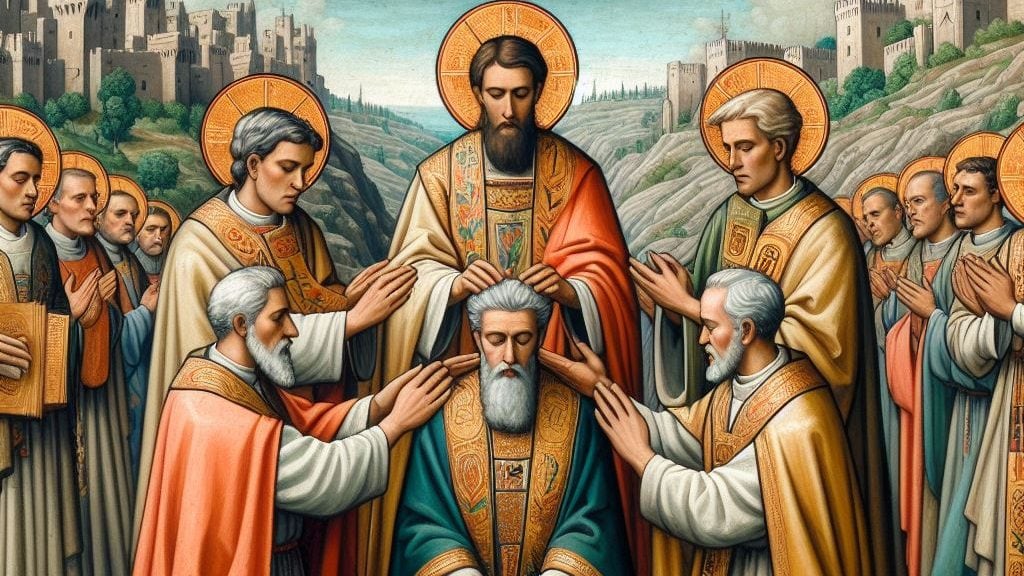
Some translations of the Bible do not contain the word “ordain” but the concept is throughout. “Ordain”, “appoint”, and “laying on of hands” are synonyms for the church’s role is setting apart a man for gospel ministry.
In Acts 14:23, Paul and Barnabas appointed elders in every church. Titus was “chosen” (“ordained”, KJV) by the churches (Titus 1:5). Paul and other elders laid hands on Timothy to appoint him to pastoral ministry (Ac. 16:3; 2Tm. 1:6).
Ultimately it is God, not man, that calls preachers into ministry. Paul reminded the Ephesian elders: “The Holy Spirit has made you overseers” (Ac. 20:28). It is Christ that “gave…shepherds and teachers, to equip the saints for the work of ministry” (Eph. 4:11-12). But the church recognizes this calling. Through much prayer and fasting the church lays hands upon these men and sends them out (Ac. 6:6; 1Tm. 5:22).
Ordination Hazards
Charles Spurgeon famously said that ordination services are an idle waste of time. He called it “empty hands…fitly laid on empty heads.” To be fair, Spurgeon was a non-conformist and didn’t oppose ordination per se, only the prejudice and fooldiggery that often accompanied it.
With this in mind, churches should be careful to avoid the following ordination pitfalls.
First, churches mustn’t discard ordination as unnecessary. Even great missionaries like Norris Groves, who was a friend Karl Rhenius, minimized ordination. His Brethren theology stopped him from seeing a real distinction between clergy and laity. But according to Scripture, not every sheep is a shepherd. Mayhem follows if everyone is a preacher.
Second, churches mustn’t ordain too quickly (1Tm. 5:17-22), or they will share in the man’s guilt should he fall. Third, churches mustn’t ordain women. God calls only men to be preachers and pastors (1Tm. 2:11-14; 3:1-7), even though this is politically incorrect in today’s world.
Fourth, churches mustn’t ordain only full-time, vocational pastors. Ordination should include lay elders because all elders have the same God-given authority (Ac. 20:17ff; 1Pt. 5:1-4).
Steps for Ordination
Various denominations practice the ordination process differently. I would propose something similar to the following four steps in ordaining a man for ministry. These measures are biblical and relatively easy to follow both at home and in a foreign context.
First, identify a godly man in your church into whom you can pour your life. Model for your Timothy a life of character and a love for true doctrine. Some believe Paul traveled about 9,000 miles by land during his missionary journeys. By walking two miles an hour, the apostle would have possessed nearly 5,000 hours of teaching time during his journeys alone. Begin by reading Scripture together. Then theological books. Eventually, study every phrase of your doctrinal statement or creed. In our case, it was the London Baptist Confession.
Second, notify the proper people of your intentions. Once you have located an elder in training, notify both the man and the church. They may see things, either for or against, that the elders of the church cannot see. This will also give the prospective elder a chance to run or rejoice. Don’t be disheartened if the man does not initiate his sense of calling into ministry. Often outsiders see God’s hand upon a servant before the man himself, as Moses did with Joshua and Paul did with Timothy.
Third, plan an Ordination Exam. By this time you may have invested several years of training into your Timothy. If the church and elders continue to approve, it’s time to organize an Ordination Exam for Timothy. The purpose is not to trick the candidate with obscure theological questions. Instead, the goal is to test Timothy’s biblical and theological acumen. The church has already confirmed his character.
In our case, we had a panel of seven pastors from likeminded churches to question Timothy. The exam lasted about three hours and contained about one hundred questions which covered Bible Knowledge (“Show us from Scripture where repentance is necessary for salvation”), Systematic Theology (“What is God’s prescriptive will?”), Practical Theology (“Tell us about your prayer life”) and Church History (“Why does your church celebrate Reformation Day?”). We used the headings of the 1689 as our guide. The pastors raise their hands, ask brief questions, and then Timothy (while sitting up front with his Bible) answers the questions concisely. We encourage him to be honest if he doesn’t know the answer.
We encourage the congregation to sit in and watch, though they are not allowed to ask questions. We elect a clerk to record all of the questions. The simplest method is a pad of paper. In our case, the clerk used an Excel spreadsheet and recorded every detail of the questions.
Afterwards church leaders ask the Exam Council if they agree with the elders that Timothy is fit for the ministry. After hearing their thoughts, should they be affirmative, the elders ask the Council to sign their names upon an Ordination Certificate. The church is then notified about the future Ordination Service.
Finally, lay on hands during the Ordination Service. This is often during the Sunday morning service, when the most people can participate, but it doesn’t have to be. Briefly remind the congregation the purpose of ordination. Perhaps preach a sermon on an ordination text.
Use vows for both the candidate and the congregation, reaffirming their commitment to this sacred task. Lay hands upon the man as the elders pray. Give him his certificate as a record of this special day. Then rejoice.